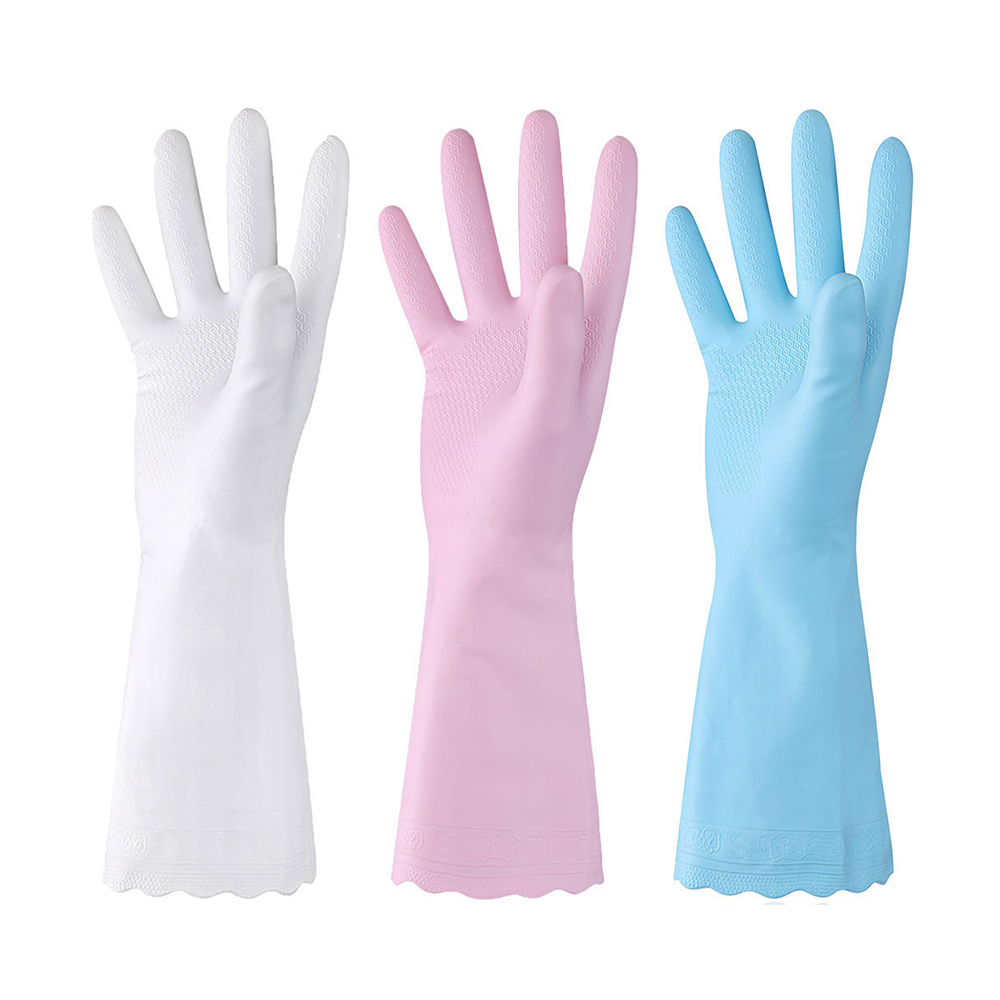
A household glove can look convincing in a photo and still fail a retail launch: poor fit, an awkward cuff, inconsistent grip, or a pack whose barcode and claims were never checked for the destination market.
For a buyer developing latex household gloves, the real decision is not simply whether a sample looks good. It is whether one defined glove and one defined pack can be reproduced, inspected, shipped, and sold under the intended claims. A private-label brand, importer, or supermarket buyer needs a record that connects the physical reference sample to the quotation, artwork, purchase order, and pre-production approval.
Direct answer: Approve reusable latex household gloves as a complete retail SKU. Confirm the model and material, fit by size, length and cuff, lining, grip texture, workmanship, pack configuration, market-specific claims and documents, and a signed reference sample. Release the bulk order only when the agreed specification, artwork, tolerances, and change-control process refer to the same version.
This guide is for reusable gloves used in dishwashing and routine household cleaning. It does not assume that a kitchen-cleaning glove is suitable for direct food contact, industrial chemical protection, or every person with latex sensitivity. Those are separate decisions requiring evidence for the exact model and market.
Start with one intended retail SKU
Before requesting a sample, describe the SKU a shopper will actually see. “Household gloves” is too broad: the same range may contain light kitchen-cleaning gloves, longer-cuff bathroom-cleaning gloves, lined variants, and different colors or pack formats. Write down the use case, target customer, retail channel, destination market, planned size range, and whether the product will carry your brand.
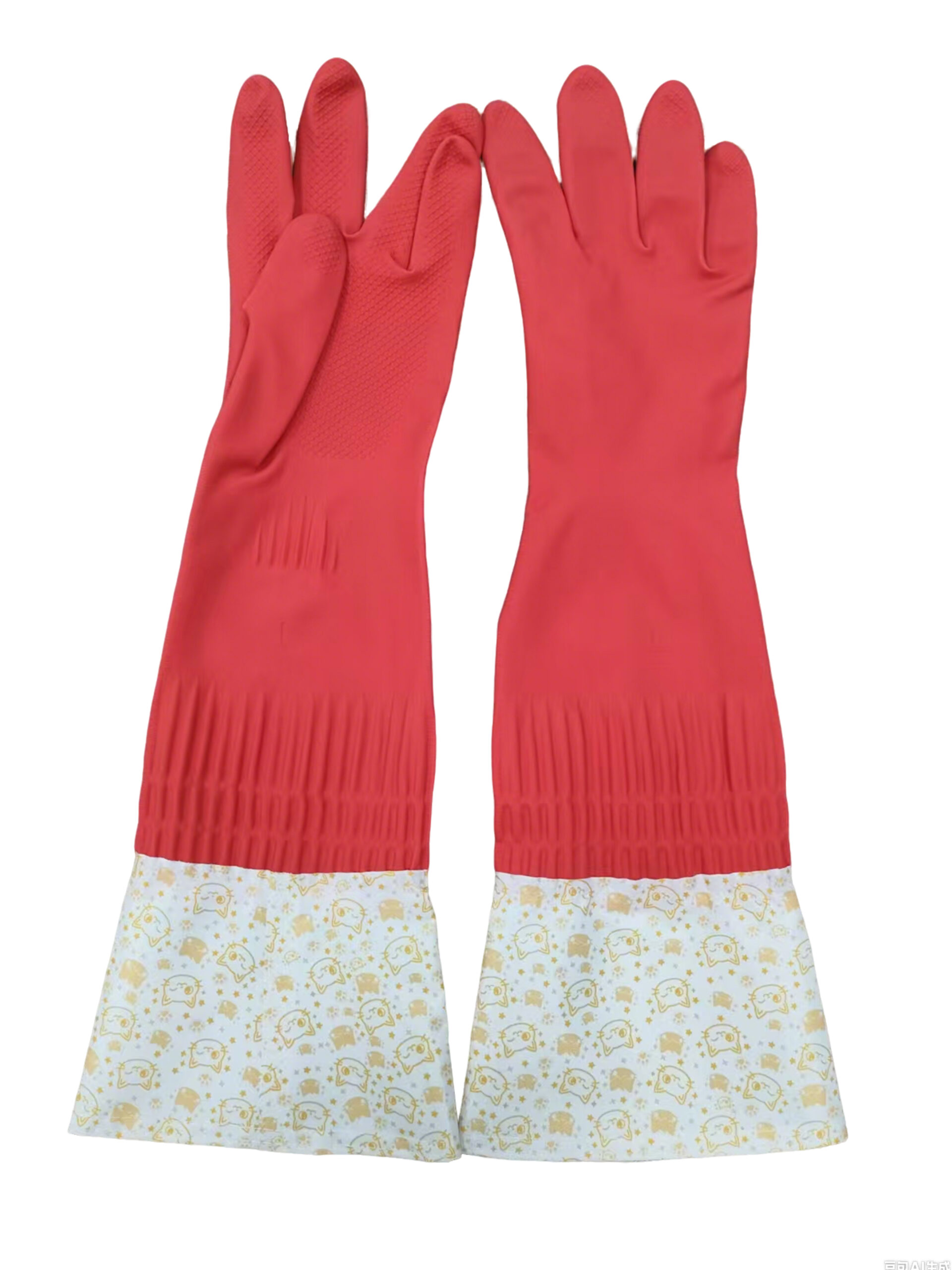
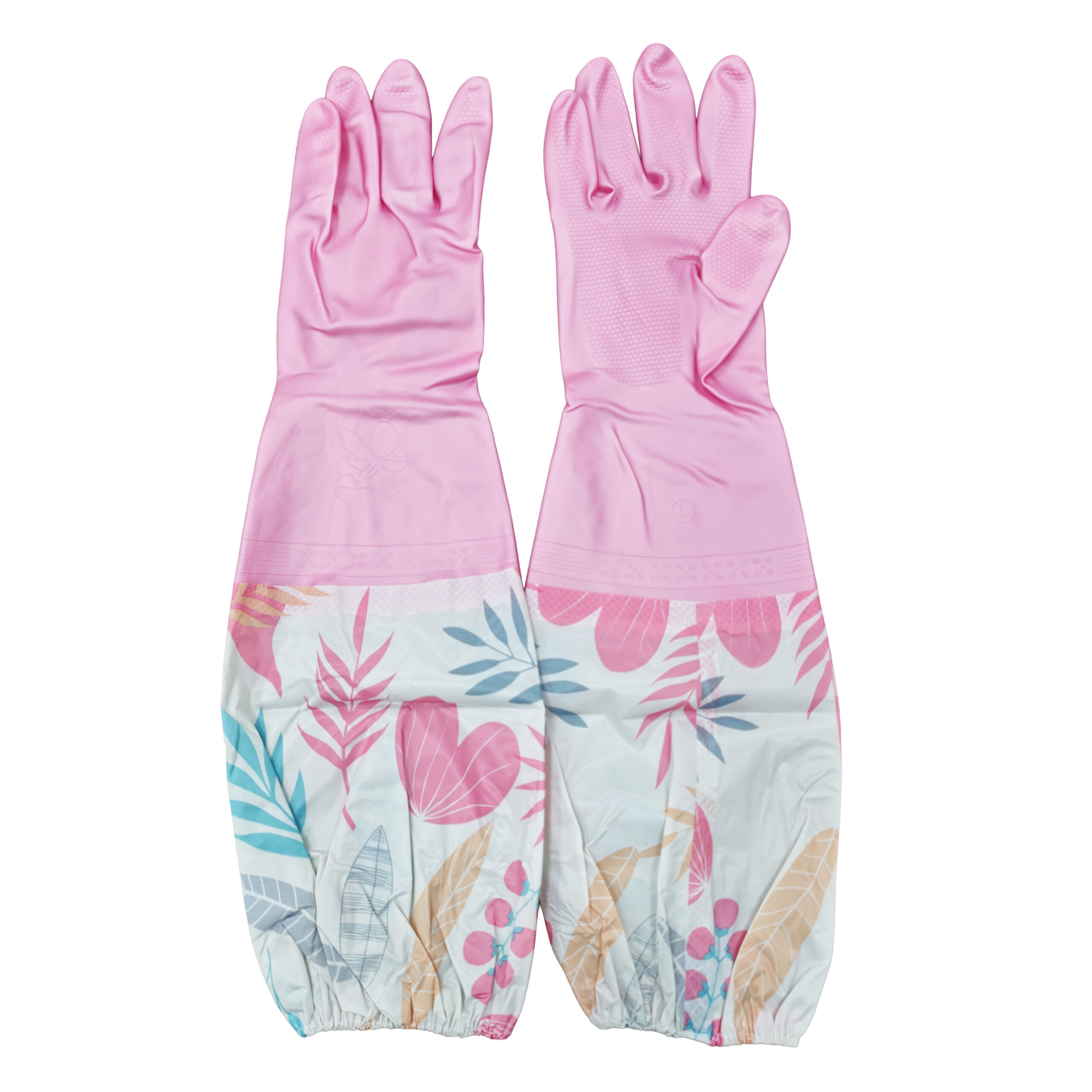
This prevents a common comparison error: a quote for a standard pair against a sample of a longer, lined, two-color design in a printed sleeve. Both are latex household gloves, but the work and cost differ. Identify the model behind each sample and quote; label unfinished designs as provisional.
The choice between latex kitchen gloves and latex cleaning gloves is also about claims. “For dishwashing” describes a use case; “suitable for direct food contact” is a distinct claim requiring product-specific evidence and destination-market review. See the European Commission’s food-contact materials overview for EU-bound goods.
Nine checks before approving latex household gloves
| Check | What to examine on the actual sample | What to record before approval |
|---|---|---|
| 1. Model and material | Confirm reusable natural rubber latex and the exact model or development code. | Model identifier, material declaration, color, intended use, revision. |
| 2. Fit and size | Try every planned size, not only medium; inspect finger length, palm width, thumb position, and hand entry. | Size chart, measurement points, size mix, accepted fit reference. |
| 3. Length and cuff | Check wrist/forearm coverage, cuff opening, rolled or straight edge, and sleeve interference. | Length and cuff dimensions, construction, tolerance. |
| 4. Lining and feel | Check flocking or other lining only where specified; examine shedding, tackiness, and ease of removal after use. | Lining type, location, appearance standard, sample photos. |
| 5. Grip pattern | Inspect palm and fingertip texture in dry and wet handling, including its location and consistency. | Texture reference photos, required areas, acceptable variation. |
| 6. Workmanship | Look for thin spots, pinholes, tears, color defects, uneven edges, and pair mismatch. | Defect definitions, inspection method, acceptance criteria. |
| 7. Retail pack | Assemble the actual pair in the proposed pack and test fit, visibility, barcode area, and case count. | Final artwork, pack dimensions, pieces per pack and carton, barcode proof. |
| 8. Claims and documents | Review material, use, care, safety, and any compliance language against evidence for this model. | Approved claims list, market language, current test documents where needed. |
| 9. Approval control | Compare the sample, spec sheet, quotation, artwork, and purchase order. | Signed reference sample, revision number, sign-off date, change process. |
The table is a decision tool. Mark an irrelevant feature “not applicable” rather than leaving its field blank.
1. Verify model identity before comparing price
Ask for the model identifier and a written description of the physical sample. Note the material, color, approximate purpose, and whether any dimension or finish is custom. If a quotation lists only “rubber glove,” request a revised line item. For latex household gloves, a model code makes later questions answerable: Which sample was approved? Which artwork belongs to it? Which product document applies?
Natural rubber latex should be identified plainly on the retail information. Latex may trigger sensitivity in some users; the OSHA natural-rubber-latex bulletin explains the underlying concern. Do not describe a latex glove as “latex-free,” and do not make broad allergy-safety promises. If the channel needs a non-latex option, make that a separate assortment decision and evaluate the actual alternative model.
2. Test the whole size range, including the planned mix
Medium-only approval is a weak basis for a multi-size retail program of latex household gloves. A glove may grade unevenly: a larger size may have proportionally short fingers, or a smaller size may be difficult to pull on. Have representative users try each planned size during the intended cleaning task. Ask them to note hand entry, thumb movement, fingertip reach, and whether the glove twists while gripping a wet object.
Record measurement points and accepted ranges for each size; size names alone do not define palm width. Set the size ratio from your channel forecast rather than assuming a supplier’s standard mix fits your market.
3. Check cuff coverage in the real task
For dishwashing, the cuff of latex household gloves must suit the sink and arm movement. Bathroom cleaning may require different coverage. Longer is not automatically better: it adds bulk and can affect packaging and comfort.
Check that edge construction matches the reference: rolled, straight, reinforced, or two-tone. A ruler photo and cuff close-up can clarify the specification across buying teams.
4. Decide whether lining is part of the SKU
Flock-lined latex household gloves can feel different from unlined versions and may suit a different shopper preference. The lining specification should state what is present, where it should appear, and how much variation is acceptable. Examine the inside after repeated donning and removal during sampling. Look for visible shedding, patches, trapped debris, or an uneven feel.
Do not call every interior finish “cotton-lined.” If offering lined and unlined latex household gloves, give each its own model identifier, approval, and pack description.
5. Check grip where it is actually molded
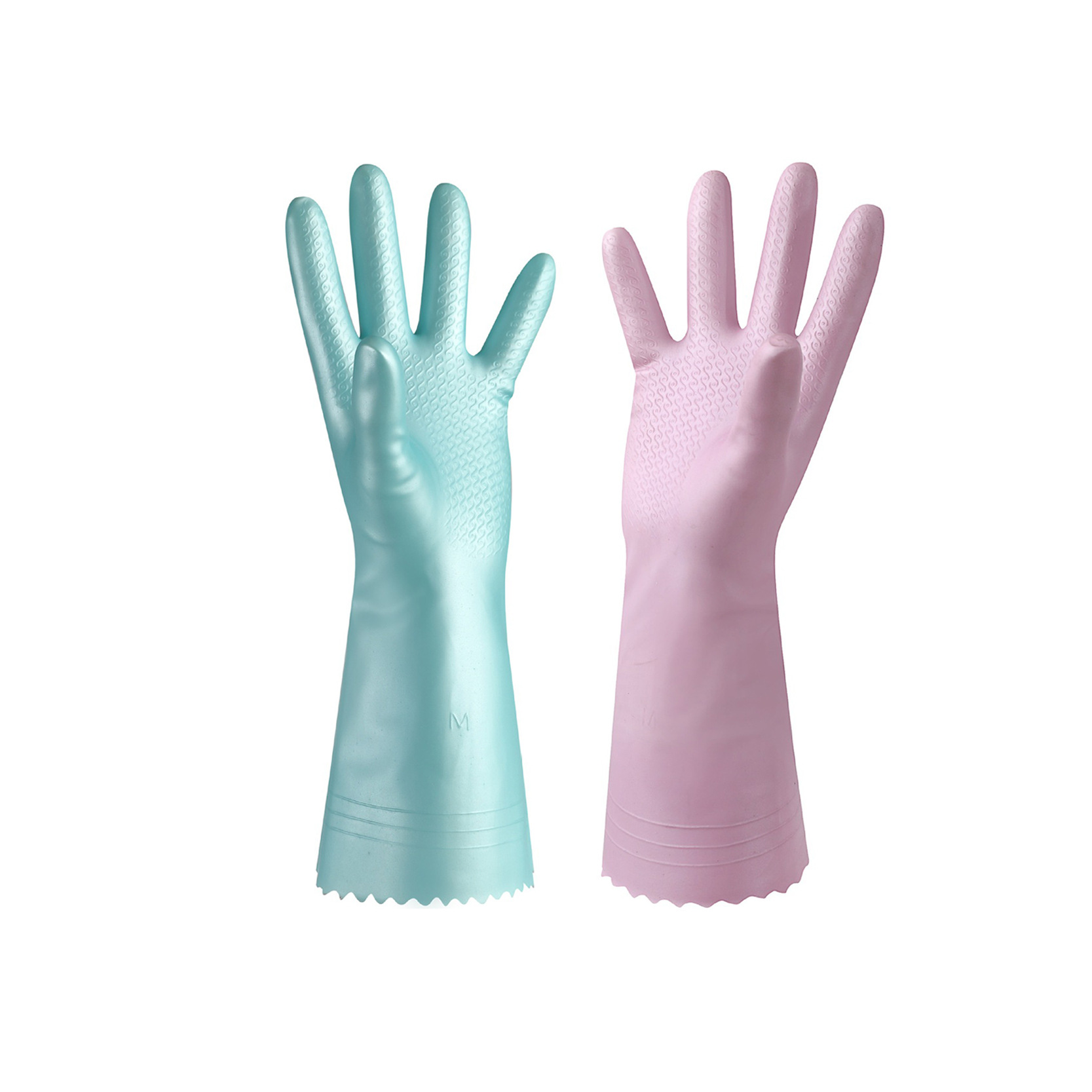
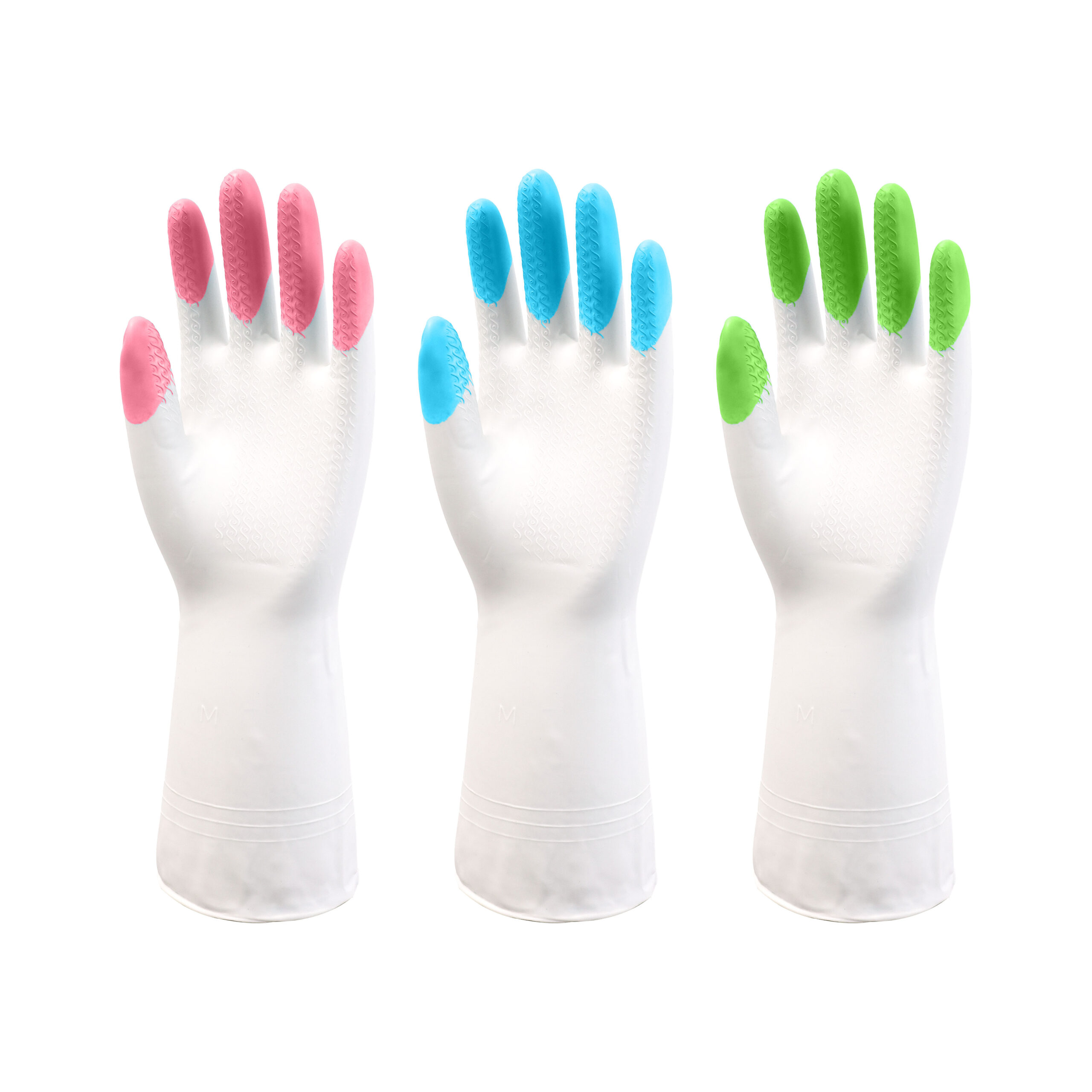
A claim that latex household gloves are “non-slip” is too broad unless the buyer knows the surface and use condition. Examine the palm and fingers under clear light. Record the texture shape, density, and exact areas covered. Test the sample with the wet household objects relevant to the intended use, then describe what was observed without turning a simple handling trial into a laboratory performance claim.
The production sample should preserve the approved pattern. A smooth palm in place of fine raised texture changes the retail proposition. Keep product artwork and inspection photos faithful to the actual glove.
6. Define visible defects and an inspection method
An attractive first sample of latex household gloves does not establish production consistency. List the defects that matter to your channel: tears, obvious thin spots, holes, sticking, dirt, color variation outside the agreed range, uneven edges, and left/right mismatch. Agree on how the finished lot will be inspected and how a disputed result will be handled. The detailed sampling plan and acceptance numbers should come from a negotiated quality agreement, not a generic blog statement.
For latex household gloves, inspect several pairs and photograph the palm, back, fingertips, inside, and cuff. Record any informal water or air check as an observation, not a certified protection rating.
7. Approve the pack as carefully as the glove
For latex household gloves, retail failure can begin at the pack line. Place the actual pair inside the proposed bag, sleeve, or carton insert. Does it fit without severe folding? Is the size clear from the shelf-facing side? Can a shopper tell which product is lined and which is not? Are color and material descriptions accurate? Does the pack protect the product during normal handling without adding unnecessary bulk?
Confirm the unit of sale, packs per inner, cartons per order, carton dimensions, labels, and destination-market language. Your retailer or distributor should approve the barcode format and scan proof. GS1’s Ambition 2027 guidance says the retail industry aims for POS systems to read specified GS1 2D barcodes by the end of 2027, with varying local implementation timelines. That is a planning signal, not a blanket instruction that every glove pack must switch immediately. Ask the selling channel what it requires for this launch.
Version the artwork consistently across approval, production file, and purchase order. Obtain a production-representative pack proof before release.
8. Separate a use description from a tested claim
“Reusable kitchen-cleaning gloves” describes an intended use. “Chemical-resistant,” “food-safe,” “hypoallergenic,” and similar statements may require specific evidence and market review. For latex household gloves, ask which document supports each claim, whether it covers the exact model and material, who issued it, and whether it is current. A certificate for another product family, another factory, or a different destination market is not sufficient by association.
Care instructions also matter. State storage and use guidance that the manufacturer can support, especially if the intended task involves cleaning agents. Answer two practical shopper questions on the pack: can the glove be reused, and how should it be cleaned? Household gloves are not automatically suitable for concentrated chemicals or industrial exposure. If the buyer plans to make a direct food-contact statement, seek model-specific testing and destination-market advice before printing it. If a claim cannot be supported, remove it or narrow the wording.
9. Make the approved sample the order reference
The strongest handoff is one approval file: model code, photos, measurements, color, grip, lining, artwork, carton details, claim/document list, and dated sign-off. Identify the controlling version and any open issue.
Agree on change control before production. A different liner, color, cuff, or pack material may require a new sample and artwork sign-off. Distinguish authorized revisions from unapproved departures.
A practical sample-approval sequence
First, send an RFQ for latex household gloves with the application, market, price tier, material, lining, size range and ratio, length, grip, pack format, approximate volume, and launch window. Ask the supplier to confirm any missing field before quoting.
Second, request a sample of latex household gloves with a clearly named model. Evaluate it as a glove, then as part of a complete retail pack. Capture discrepancies in one document: issue, photo, requirement, owner, and decision. “Color slightly wrong” is not enough; compare it with a physical swatch or agreed color reference under suitable light.
Third, ask for a revised sample only for the items that changed. Keep the original and revised versions separate. Once the glove is acceptable, request a pre-production sample or pack proof that represents the final materials, artwork, and assembly. It should be clear whether that proof is an actual production sample or a design mock-up. Do not treat a digital rendering as physical approval.
Finally, release the purchase order with the spec revision, signed sample reference, artwork version, quantity by size, agreed inspection plan, packaging details, documentation requirements, and milestone dates. This sequence may feel formal for a simple household product, but it is much easier than resolving mismatched cartons after shipment.
Commercial details that should travel with the specification
MOQ is a quote for a particular configuration, not a universal property of latex household gloves. A standard model in neutral packaging may have a different minimum from a custom color, printed sleeve, or unusual size mix. Ask the supplier to separate the glove minimum, packaging print minimum, and any one-time artwork or tooling cost. Confirm whether a mixed-size order counts as one design or several lines.
Likewise, lead time should start from a named event: payment, signed artwork, approved pre-production sample, or material availability. Ask for the sequence and the point at which changes become costly. For imports, include transit planning and destination-side review rather than assuming the production date is the shelf date. The WTO’s October 2026 outlook describes uneven global trade conditions; it cannot predict the schedule for this glove order. Obtain an order-specific commitment.
Compare quotes only after normalizing delivery term, carton configuration, documents, packaging, and change costs. A loose-pair quote is not equivalent to a retail-ready pack quote.
Red Sunshine publicly presents a range of reusable household gloves and private-label services. For a specific program, the useful next step is to send the intended use, market, reference model or photo, size mix, packaging concept, and estimated quantity. The team can then confirm which actual model and documents are available. Do not infer a fixed MOQ, lead time, certification, or performance rating from the general range page; request the current model-specific quotation and evidence.
Questions buyers often ask during approval
Can one sample approve every size of latex household gloves?
No. Approve the fit and dimensions of each planned size, then record the intended size mix. A medium sample cannot reveal a grading issue in small or large. The final specification should state measurement points and tolerances for each size.
Should kitchen and cleaning versions share a product code?
Only if the physical glove, pack, claims, and approved use are genuinely the same. If the cuff, lining, color, length, or claims differ, separate codes make replenishment and complaint handling clearer. A kitchen-cleaning description does not prove direct food-contact suitability.
What should a private-label buyer send with the first inquiry?
Send the target application, material, preferred lining, size range and approximate ratio, length and cuff preference, grip requirement, target market, estimated quantity, and packaging concept. Add the artwork or barcode requirements if they are ready. A photo of a benchmark glove helps, but the final quote still needs a defined specification.
When should artwork be approved?
After the product and pack structure are defined, and before production printing. Review a physical or production-representative proof for size identification, material wording, legal text, barcode scanning, and carton marks. Record the version and approval date.
What evidence is needed for a latex household glove claim?
It depends on the exact wording and market. Match each performance, safety, food-contact, or compliance claim to current documents covering the particular model and intended use. If the documents are unavailable, omit or narrow the claim. Never transfer a certificate from another glove line by assumption.
What is the final order-release check?
Make sure the signed sample, latest spec, artwork, quotation, purchase order, inspection criteria, and delivery milestones all name the same product revision. Resolve open discrepancies in writing. Only then treat the retail SKU as approved for production.
The buyer’s decision
The best reusable latex household gloves for a retail program are the ones that fit its shopper, task, price tier, and market requirements and can be supplied against a stable, agreed reference. The nine checks turn a visually attractive sample into a controlled purchasing decision. If the sample and pack are both approved, the next conversation with the manufacturer can be specific: which model, which changes, which evidence, which quantity, and which deadline.
If you are building a private-label household range, share that brief with Red Sunshine. Ask for the closest current model and a model-specific sample and quotation; approve the actual glove and retail pack before releasing the order.